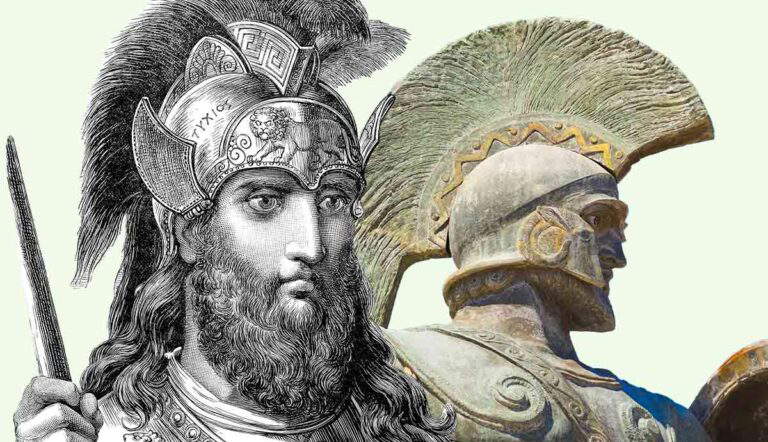
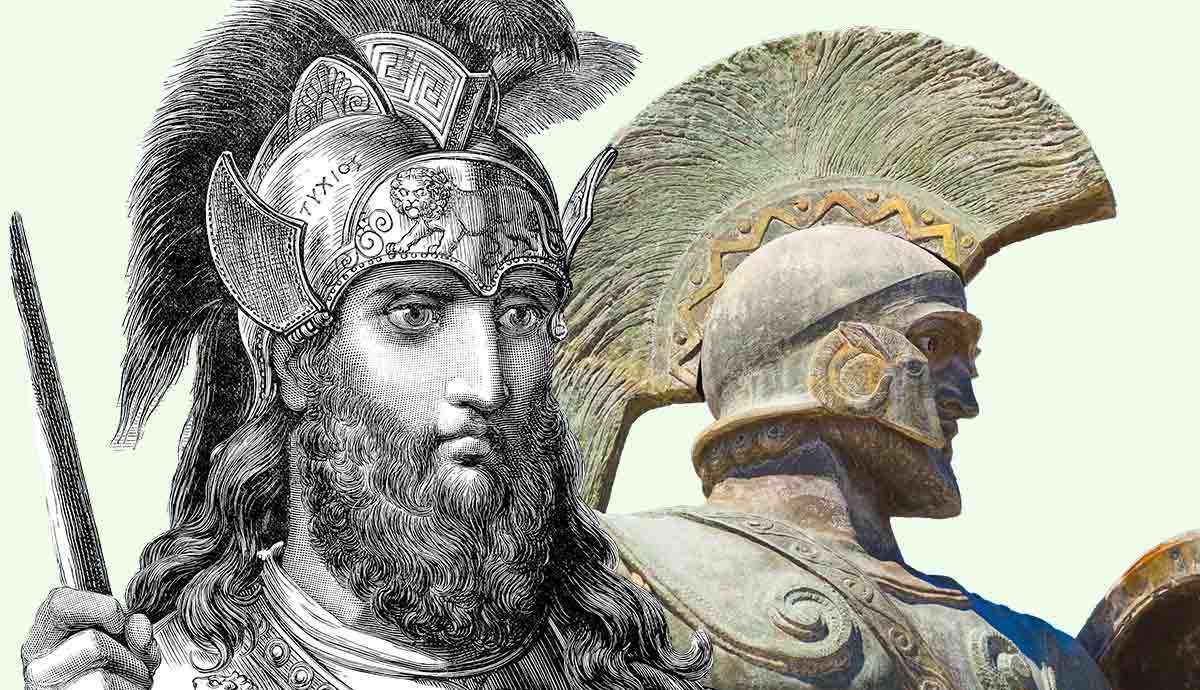
The heroic last stand of King Leonidas of Sparta and his elite bodyguard of 300 men against the Persian army at the Battle of Thermopylae in 480 BC is one of the best known episodes from the history of ancient Greece. Despite Leonidas’s fame, most of what we know of his life comes from a few short passages in the Histories of Herodotus. Many details of his life and kingship before his climactic death at Thermopylae have to be inferred from the context of Spartan politics and the Graeco-Persian Wars.
A Spartan Prince

Leonidas was born in c. 540 BC into the Agiad dynasty, one of the two royal dynasties in the city-state of Sparta. For hundreds of years, Sparta was jointly ruled by two kings from the Agiad and Eurypontid dynasties. This unusual arrangement avoided the excesses of an autocratic regime, but often encouraged competition and rivalry between the two kings.
Leonidas was the third son of King Anaxandridas II of Sparta, who reigned for approximately four decades between c. 560 BC and c. 520 BC. According to Herodotus, Anaxandridas had initially been married to a niece who remained childless for several years. He refused demands to divorce his wife but agreed to take a second wife while remaining married to the first. After his second wife bore him a son named Cleomenes, Anaxandridas’s first wife gave him three more children: Dorieus, Leonidas, and Cleombrotus.
As the third son of Anaxandridas, Leonidas was not expected to succeed to the kingship. Like all boys of the Spartan citizenry, at the age of seven he would have been separated from his family to undergo the Agoge, an arduous physical training regime to prepare Spartan men for military service. At the age of 18, the most accomplished young men would join an elite body that included senior army officers and members of the 300-strong royal body guard.
The Age of Cleomenes
Following the death of Anaxandridas in around 520, the Spartans recognized his eldest son as King Cleomenes I. The succession was challenged by Dorieus, who claimed seniority by virtue of being the eldest son of Anaxandridas’s first wife. After being forced into exile, Dorieus attempted to set up his own power base in North Africa and later Sicily, but was killed in battle in around 510. While Leonidas was now the heir of the childless Cleomenes, little is known about his life during his half-brother’s reign. However, Cleomenes’s reign would have profound consequences for Leonidas’s reign decades later.
After vanquishing Dorieus, Cleomenes proved to be one of Sparta’s most ambitious kings. In 510, Cleomenes led a Spartan invasion of Athens to overthrow the Athenian tyrant Hippias. While the Spartans hoped to install a pro-Spartan oligarchy, the Athenian statesman Cleisthenes introduced democratic reforms, prompting Cleomenes to consider further intervention in Athens.
In 506, the Spartan kings Cleomenes and Demaratus launched a campaign against Athens at the head of a large Peloponnesian army. However, the alliance soon disintegrated after the Corinthians withdrew from the coalition, prompting Demaratus to follow suit and abandon the campaign. The disintegration of the Spartan alliance may have been due to a news of a recent Athenian alliance with the Persian Empire, but the incident fatally undermined relations between the two Spartan kings.
At the turn of the century, Cleomenes refused to join the Ionian Revolt against Persian rule. Instead, Sparta went to war against Argos in 494 and destroyed the Argive army in battle. However, after returning to Sparta, Cleomenes was put on trial for failing to occupy the city. Although he was acquitted, the trial may have been an attempt by Demaratus to undermine him.
King of Sparta

In 491, following another disagreement between the joint kings, Cleomenes deposed Demaratus after bribing the oracle in Delphi to pronounce Demaratus illegitimate. Demaratus fled Sparta and was granted refuge in the Persian Empire. Cleomenes’s corruption was soon exposed, and Herodotus claims that the king became insane and fled the city. He was captured and imprisoned in 490 and subsequently took his own life in prison.
Modern historians such as Paul Cartledge suggest that Cleomenes may have been killed by his half-brothers Leonidas and Cleombrotus. In any case, Cleomenes’s death elevated Leonidas to the Spartan kingship alongside Leotychidas, the Eurypontid king whom Cleomenes had installed as Demaratus’s successor. To consolidate his position, Leonidas married Cleomenes’s daughter Gorgo.
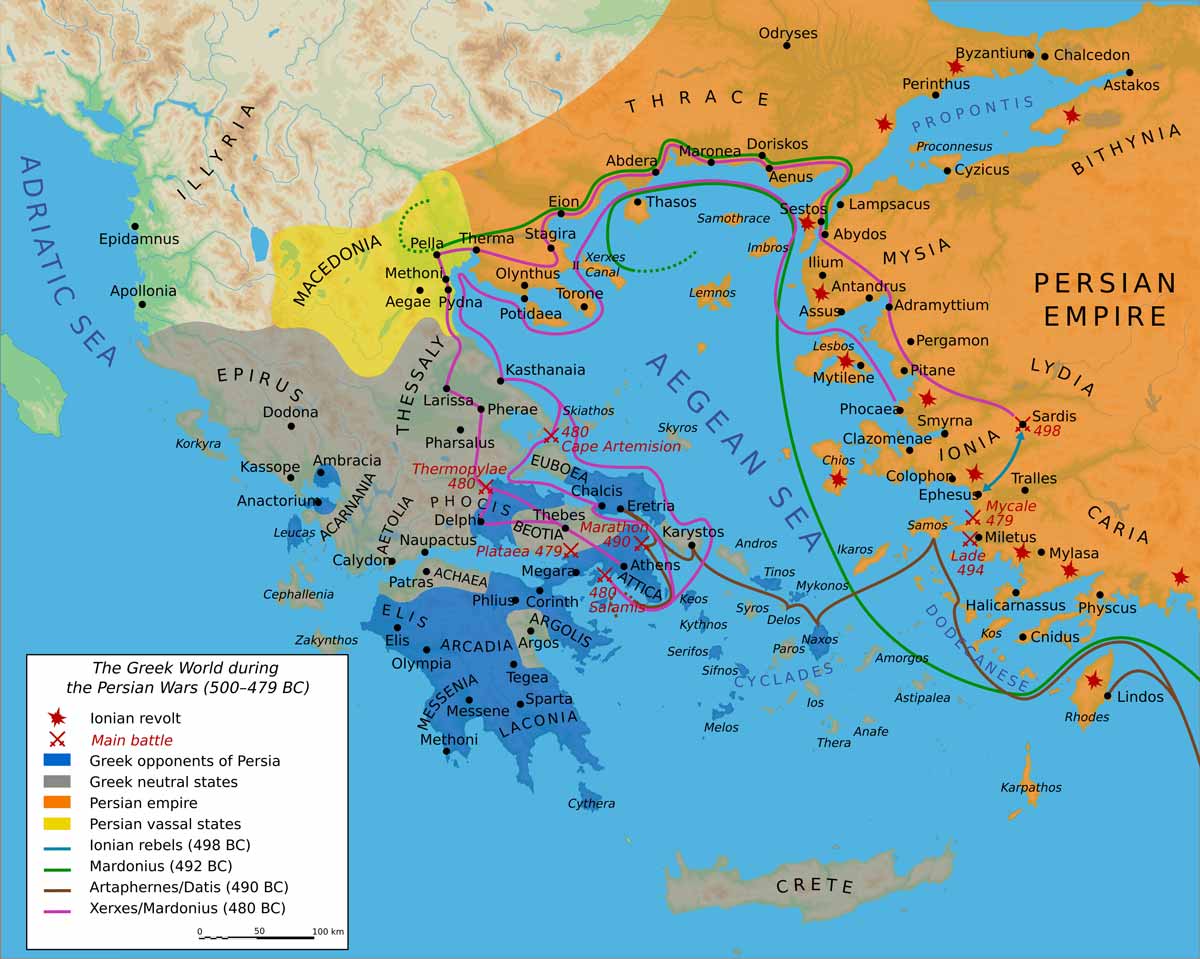
Leonidas came to the throne during the Greco-Persian Wars, although it is unclear if he was already king when Athens requested Spartan assistance against the Persians in 490 BC. The fact that the Persians were harboring the deposed Demaratus engendered Spartan hostility towards the Persians, and Sparta was prepared to march to Athenians’ aid once they finished celebrating the Karneia festival. In the event, the Athenians defeated the Persians at the Battle of Marathon without Spartan assistance.
The Battle of Marathon forced the Persians to abandon their first invasion of Greece. The death of King Darius I in 486 BC and his son Xerxes’s efforts to consolidate his rule in response to a series of uprisings across the Persian Empire allowed the Greeks some respite from further Persian invasion.
The Anti-Persian Coalition
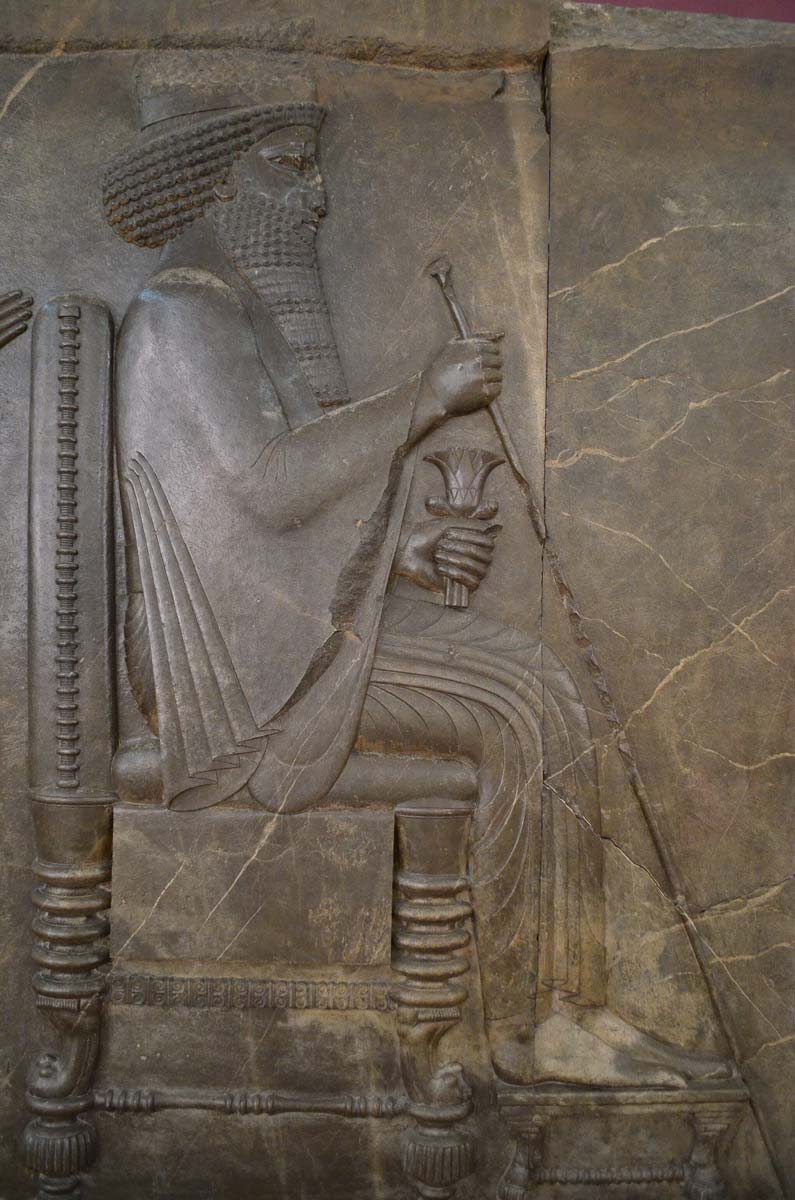
By the late 480s, once Xerxes had restored order in his empire, the Persian king began preparations for a second invasion of Greece. According to Herodotus, the Spartans received advance warning of the Persian invasion from the exiled Demaratus, who sent a secret message in a tablet covered in wax. The Spartan men were initially confused by the blank tablet, and it was only after Leonidas’s queen Gorgo suggested burning off the wax that the secret message was revealed.
The Spartans responded by inviting the 30-odd Greek city-states committed to resisting the Persians to a meeting at the Isthmus of Corinth to consider the military response. While Sparta and Athens were the leading powers in the coalition, around half of the city-states were members of the Spartan-led Peloponnesian League. This ensured that Spartans would command Greek forces on both land and sea.
As King of Sparta, Leonidas would have played a major part in formulating the coalition strategy. The Greek allies identified a series of three defensive positions where they could expect to resist larger enemy numbers on equal terms. The first was the Vale of Tempe in Thessaly in Northern Greece. The second was the narrow pass of Thermopylae at the Malian Gulf. The third was the Isthmus of Corinth itself, which connected the Peloponnese to the rest of Greece.
Xerxes’s invasion force crossed the Hellespont in the spring of 480 BC and slowly progressed southwards towards the Vale of Tempe. A Greek force of 10,000 was initially deployed to defend the position, but withdrew after being informed by King Alexander I of Macedon that that the position could be outflanked.
Thermopylae
During the summer, the Greek city-states were prevented from mobilizing their full manpower since they had religious obligations to celebrate the Olympic Games in honor of Zeus. Meanwhile, the Spartans were also due to celebrate the Karneia festival dedicated to Apollo that had prevented them from fighting at Marathon a decade earlier.
At this critical juncture, the Spartans sought guidance from the famous oracle at the Sanctuary of Apollo at Delphi, which informed them that either Sparta would be occupied, or they would be mourning the death of a king.
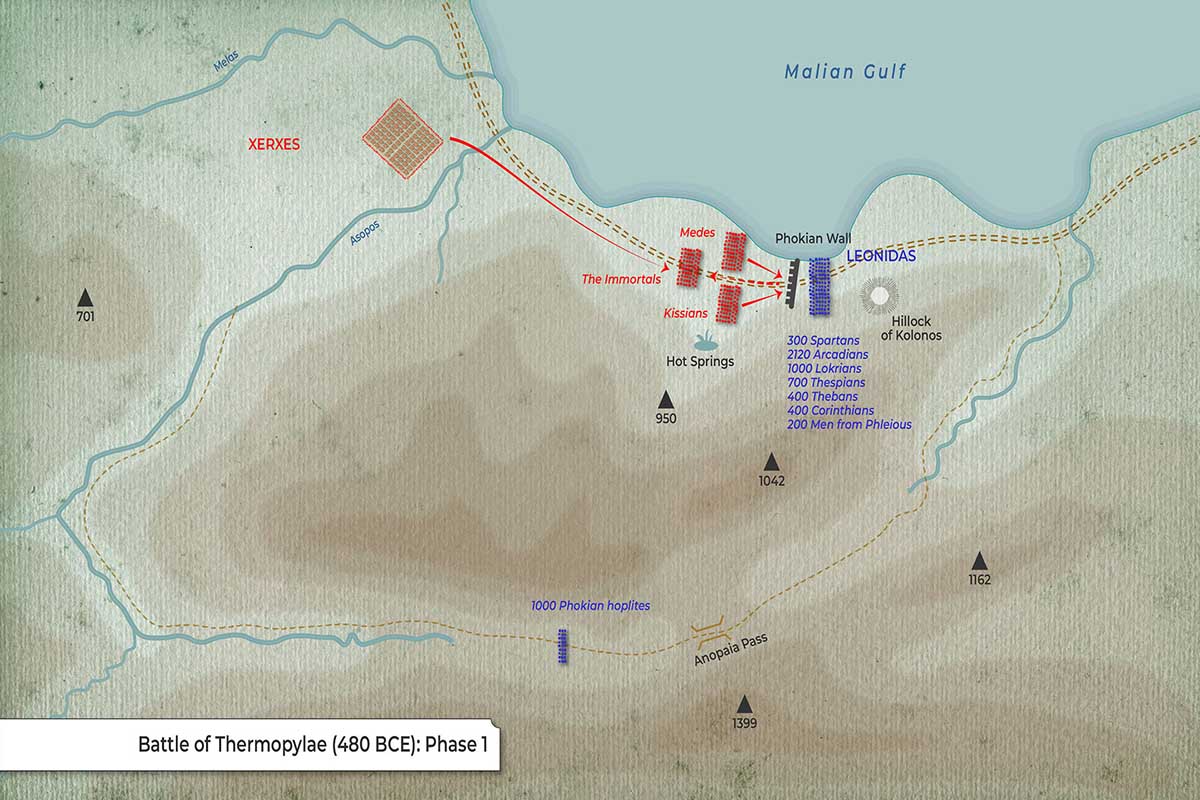
After receiving the oracle’s answer, King Leonidas left for Thermopylae with his elite royal bodyguard of 300 hoplites. The Spartan contingent also included 1,000 enslaved Helots and a similar number of Perioikoi, free men recruited from the Spartan hinterland. Including various allied contingents, Leonidas marched to Thermopylae with some 4,000 men.
At Thermopylae, they were joined by around a thousand Boeotians, Locrians, and Phocians each. Leonidas’s 7,000-strong army was still a fraction of Xerxes’s invasion force, which modern historians estimate in the tens of thousands. Although he knew there was no prospect of defeating the Persians, Leonidas hoped that he could delay them long enough for the other Greek states to mobilize their forces at the end of the festivities.
Upon arrival at Thermopylae, Leonidas fortified an old Phocian wall while Xerxes offered him various inducements to surrender. When a Persian envoy asked the Greeks to hand over their weapons, Leonidas challenged them, “Come and take them!”
For two days, the Persians suffered heavy losses as wave after wave of infantry failed to break through the wall. Even Xerxes’s famous Immortals could make no headway and were forced to retreat. Meanwhile the Greek fleet held the Persian navy at bay at Artemisium to prevent any Persian landing in Leonidas’s rear.

After nightfall on the second day of battle, a local man named Ephialtes informed the Persians of a narrow mountain pass to the rear of the Spartan position. Leonidas had known about this prior to the battle and deployed the 1,000 Phocians to defend the pass. However, they were no match for Xerxes’s Immortals, who overwhelmed them on the morning of the third day of battle.
Recognizing that his position was untenable, Leonidas intended to continue fighting to the death with his Spartans but offered the allies the opportunity to withdraw. Most of the allies agreed, but the 700 Thespians and 400 Thebans in the Boeotian force remained with the Spartans.
Leonidas ordered his men to sally forth beyond the wall, where they engaged in bitter hand-to-hand combat with the Persians. In the midst of the melee, as the Greeks sought to sell their lives as dearly as possible, Leonidas fell in combat. Nearly all the Greeks fought to the death, apart from a small number of Thebans who surrendered. For the loss of some 4,000 men, the Greeks killed 20,000 Persians in response.
Leonidas was succeeded by his young son Pleistarchus, but the new king was still a child, so Leonidas’s brother Cleombrotus assumed command of the Spartan army and prepared to resist the Persians at the Isthmus of Corinth, while the Greek fleet withdrew from Artemisium and sailed to the island of Salamis in the Saronic Gulf to prevent the Persians from landing at the isthmus.
Although the Athenians abandoned their city to the Persians, the Athenian commander Themistocles defeated the Persian fleet at Salamis and forced Xerxes to abandon his invasion. In 479 BC, Cleombrotus’s son Pausanias decisively defeated a Persian army at Plataea, bringing an end to the Graeco-Persian Wars.
Leonidas the Legend

In the decades after his death, Leonidas’s last stand at Thermopylae acquired legendary proportions. A monument of a stone lion was raised near the spot where Leonidas fell in battle, and some 40 years after the battle the Spartans recovered Leonidas’s remains from the Thermopylae battlefield. They may have been placed in a building known as the Leonidaion, which served as the focal point of public veneration for the king.
Leonidas’s legacy has endured over the centuries, and he has often been hailed as a defender of freedom against the tyranny of Persian despotism, even though Sparta itself was one of the most oppressive societies in Greece. The 16th century French essayist Michel de Montgaine argued that Thermopylae was a finer demonstration of Greek military prowess than the victories at Salamis and Plataea.
In 1814, after Napoleon fought a brilliant but ultimately unsuccessful campaign against the armies of the Sixth Coalition, French neoclassical artist Jacques-Louis David painted his grand canvas Leonidas at Thermopylae, depicting the king and his Spartans preparing to sacrifice themselves in a noble cause.
More recently, the 2006 historical action film 300 has reignited popular interest in Leonidas and the Spartans at Thermopylae. Like many retellings of the battle, it does not account for the contribution of the Helots and the perioikoi in the Spartan army, nor the allied Greek city-states, particularly the 700 Thespians who fought and died alongside the Spartans.