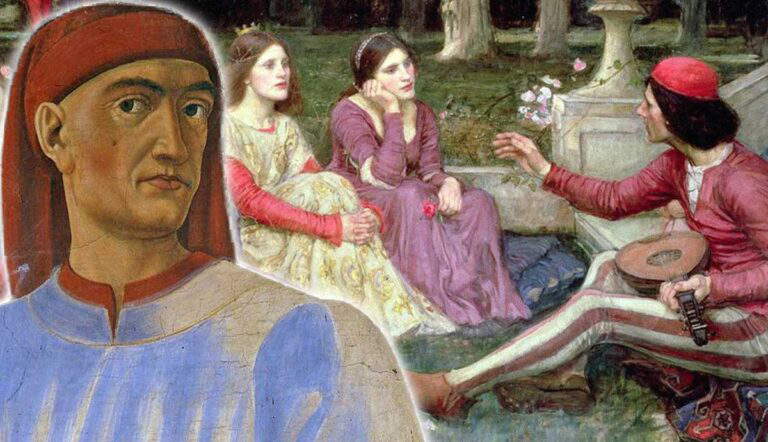
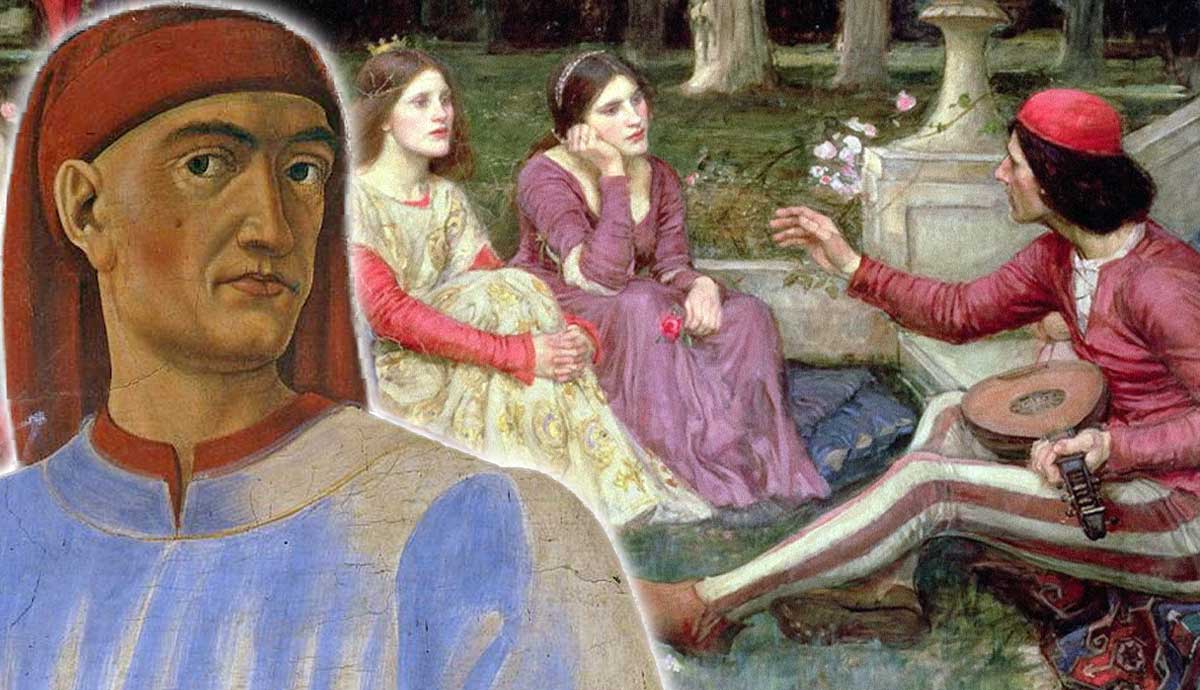
The 14th century was a time of major economic and societal changes in the Italian peninsula. As commercial activity increased and generated considerable wealth, a new social structure began to form, with new actors and a new sensibility, more focused on earthly matters than spiritual concerns. Florence, where Giovanni Boccaccio spent much of his life, was at the heart of this upheaval, which found its way into his work. Indeed, his Decameron, a collection of 100 novellas written in Italian vernacular, laid the foundations for the humanist attitude of the Renaissance, breaking with medieval sensibilities.
Who Was Boccaccio?
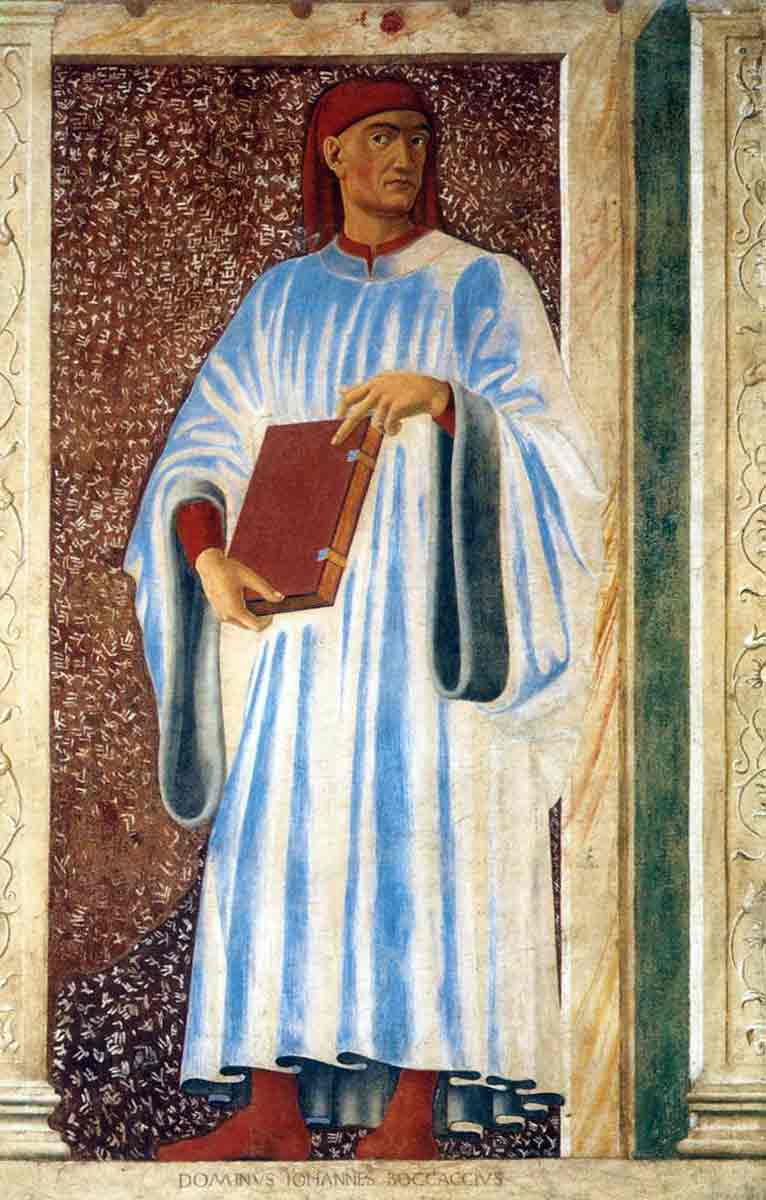
Born in 1313 in Florence or in nearby Certaldo, Boccaccio was the son of Boccaccio di Chiellino, nicknamed “Boccaccino,” and an unknown woman. A wealthy Florentine merchant, Boccaccio officially recognized his illegitimate son. Thus, young Giovanni spent his childhood years in the San Pier Maggiore neighborhood among the Florentine gente nova (new people), the rising merchant class. In 1320, “Boccaccino” had another son with his wife, the noblewoman Margherita de’ Mardoli, whose family claimed a connection with Beatrice, Dante’s muse.
In 1327, at the age of 13, Boccaccio went to Naples with his father, who had received the influential position of agent of the Bardi Bank, one of the leading Florentine financial institutions. As Boccaccio’s father wanted his eldest son to follow in his footsteps, Giovanni began working at the changing desk of the Bardi Bank’s Neapolitan office.
At the time, Naples was a major economic and political center in the Mediterranean region. His “apprenticeship” at the bank gave young Boccaccio the opportunity to interact with people from all walks of life, honing the observational skills that would inform his future literary works.
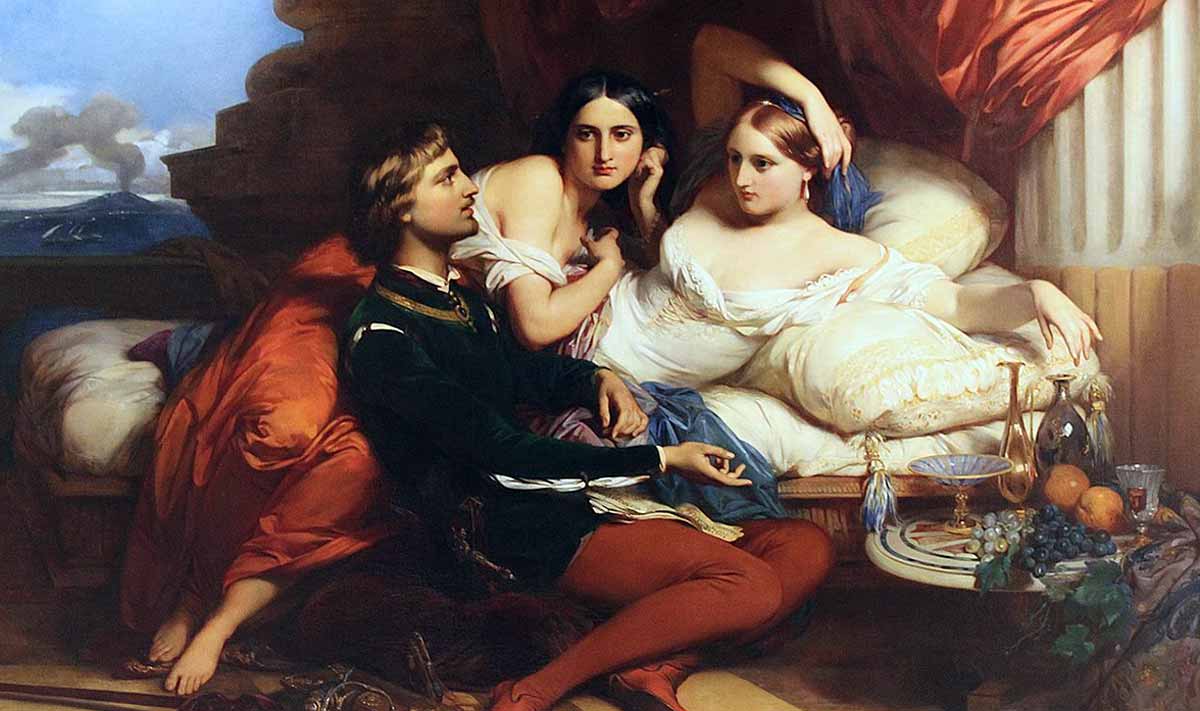
Boccaccio, as the scion of a partner of the wealthy Bardi Bank, was admitted into the Angevine court, where he mingled with the local aristocracy and experienced the courtly chivalry of an elite yearning for an old world of refined customs and traditions. In Naples, Boccaccio also pursued his literary interests, coming into contact with the city’s learned circles, where he read, alongside the Classical Latin authors, Petrarch’s poetry.
In 1340, however, following the bankruptcy of the Bardi Bank, Boccaccio was forced to return to Florence, bringing his first literary works with him: Il filocolo (The Love Afflicted, ca. 1336), Il filostrato (The Love Struck, ca. 1338), and the epic Teseida (1340-41). Combining the courtly themes of chivalry and love with Boccaccio’s acute observation of real life, these early works had an important impact on the literary circles outside Italy, serving as inspiration for Geoffrey Chaucer’s Troilus and Criseyde and The Canterbury Tales.
In Florence, Boccaccio experienced financial difficulties, especially after his father’s death during the 1348 Black Death. In the same year, the deadly plague and its impact on Florence’s society inspired him to start penning his major work: the Decameron.
Italy in the 14th Century: Society, Religion, Literature

The bubonic plague was a catalyst for crucial changes in the social fabric of Europe, shaking the foundations of the feudal system. By the time the pandemic spread in the Italian peninsula, likely carried by Genoese ships traveling between Asia and Europe, 14th-century Italy was already experiencing a period of social and political reconfiguration.
Indeed, around this time, the considerable wealth generated by the flourishing commercial activities introduced a new key player in the urban landscape: the merchant class. The increased social standing of these gente nova challenged the status quo of the Italian city-states, where the ruling aristocracy saw their power base and worldview threatened. The tensions between these two classes caused a series of social, political, and religious conflicts.
The financial and social success of the rising merchant class also marked a change in values. While the Catholic Church continued to condemn money lending, branded as usury, and commerce, the attitude toward dealing with money and amassing wealth through trade began to shift.
Meanwhile, the general dissatisfaction with the tight control of the Church over religious matters, exacerbated by the weakening of the papacy’s power during the Avignon period (1309-1377), generated friction between the religious authority and lay institutions. The result was the emergence of a new “materialistic” sensibility, which promoted, especially among the merchant classes, a renewed concern for the earthly world and the interplay between its various actors and forces.
An acute observer of the world around him, Boccaccio infused the emerging worldview taking shape in Italy at the time into his Decameron, laying the groundwork for a new, secular literature.
The Decameron: Storytelling in the Time of Plague
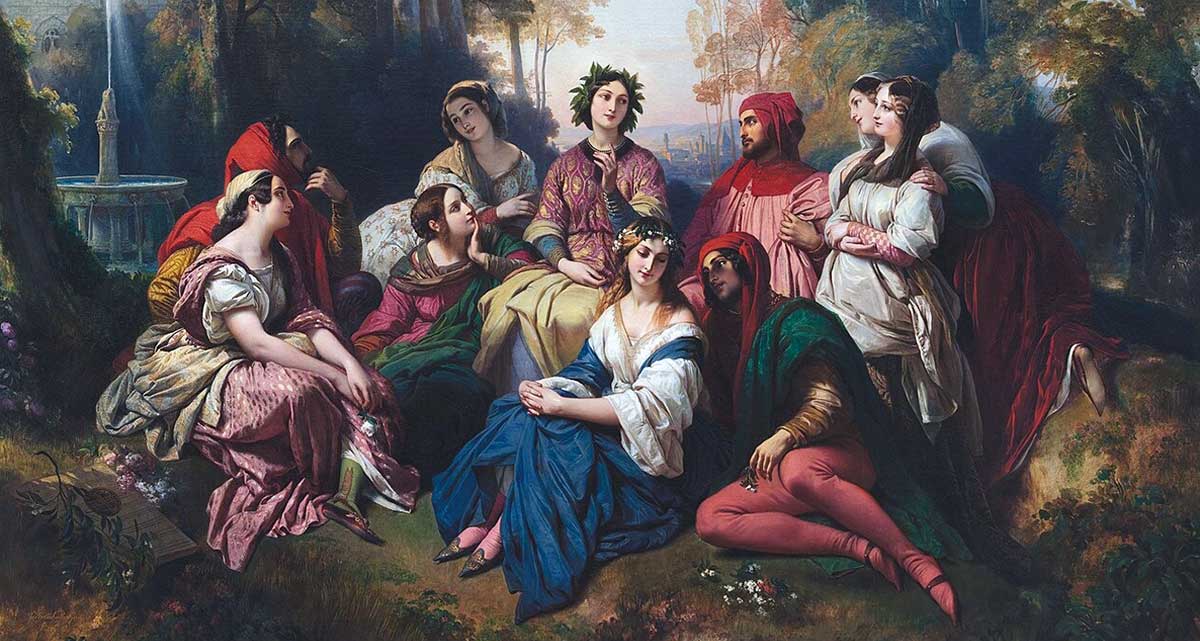
Like Dante’s The Divine Comedy, the Decameron begins with a crisis that causes chaos and social upheaval. While Dante embarks on a supernatural journey from Hell to Paradise to seek redemption, Boccaccio finds a remedy to adversities in humankind’s resilience and ingenuity.
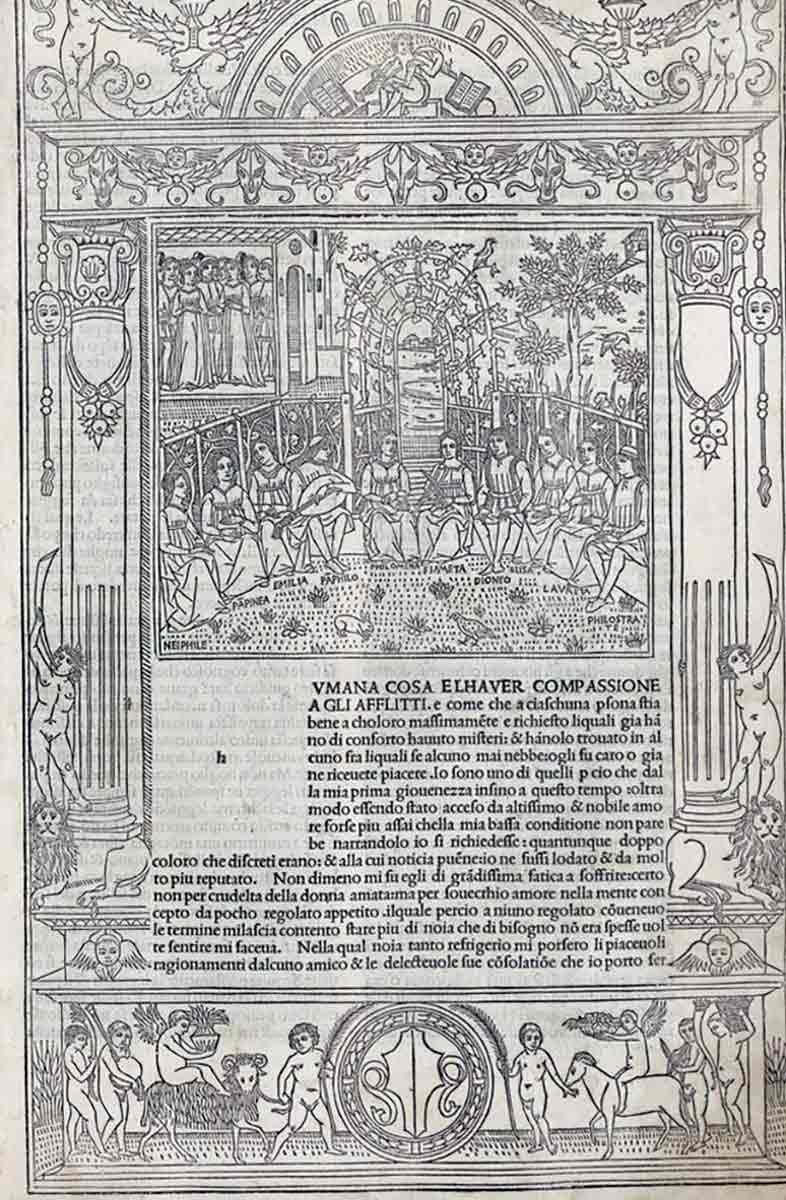
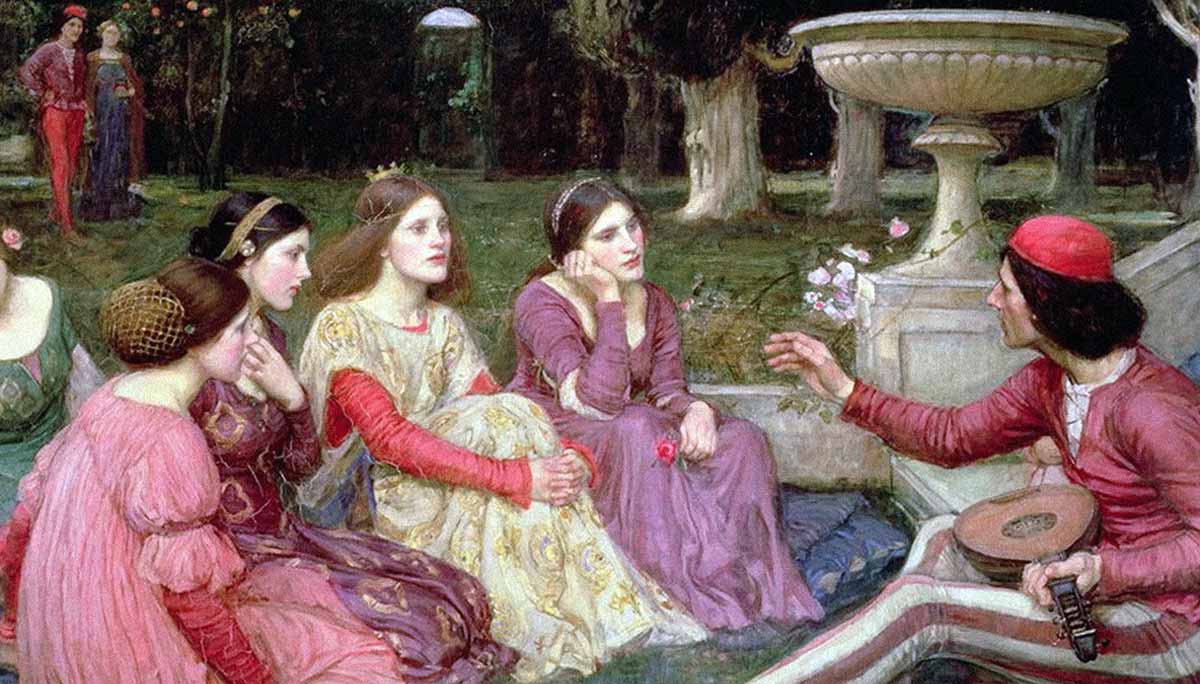
Indeed, in the proem introducing the Decameron, ten young people (seven women and three men) flee from Florence, where the Black Plague is causing death, anguish, and the breakdown of all social and moral norms. They find refuge in the countryside in nearby Fiesole, where they spend a fortnight holding banquets, dancing, playing, and inventing stories.
Every day, the brigata (brigade) elects a queen or king who directs their leisure activities and, more importantly, sets the rules for their storytelling. So, over the course of ten days (hence the title of the work, Decameron, meaning “Ten Days’ Work”), each member of the group tells a story (for a total of 100 tales). At the end of each day, the storytellers sing a ballad. In the prologues to the days and in some individual tales, Boccaccio adopts a classical style and vocabulary. However, the Decameron mostly features a vivid, swift, and tense prose.

On the first day, Pampinea allows her friends to “discourse of such matters as most commend themselves to each in turn.” The second day, under the rule of Filomena, the young men and women take turns in telling tales “of the fortunes of such as after divers misadventures have at last attained a goal of unexpected felicity.” On the third day, Neifile instructs the brigade to come up with stories where human will triumphs over fortune.
The fourth day, under the rule of Filostrato, is dedicated to tragic love stories. The following day, Fiammetta asks her companions to tell love stories where “good fortune [befalls] lovers after divers direful or disastrous adventures.” On days five, six, seven, and eight, Elissa, Dioneo, and Lauretta instruct the others to invent (often bawdy) tales focused on wit, trickery, and deceit.
After a ninth day, where, under the rule of Emilia, each member is free to choose a theme, the Decameron ends with Panfilo asking his friends to tell tales “of such as in matters of love, or otherwise, have done something with liberality or magnificence.” The final tale of the collection is The Patient Griselda, in which Boccaccio recounts the story of a popular character of medieval romance.
Key Themes: Fortuna & Amore
In the hundred tales narrated by the ten young Florentines, two fundamental forces are at play, causing various mishaps and vicissitudes: Fortuna (fortune) and Amore (love).
The idea of fortune as a force that distributed its gifts unevenly caught the imagination of many medieval writers. In their worldview, despite its apparent randomness, fortune was part of a preordained, divine plan. In Inferno VII, for example, Dante asks his guide, Virgil, about the nature of fortune. The Roman poet describes it as an agent of divine providence, giving away its gifts according to God’s inscrutable will.
With the rise of mercantile society, however, the concept of fortune undergoes a fundamental change. From an agent of divine design, it becomes a “natural,” if not yet entirely “materialistic,” force that presents a constant challenge to human enterprise. The son of a wealthy merchant, Boccaccio was well aware of how an unforeseen event can make or break a carefully devised plan.
In the Decameron, however, humankind is not helpless against the irrational turning of the “wheel of fortune.” Indeed, for one of the first times in the Middle Ages, Boccaccio praises those who use their industria (ingenuity) to struggle against adverse fortune, seizing every available opportunity to overcome it.
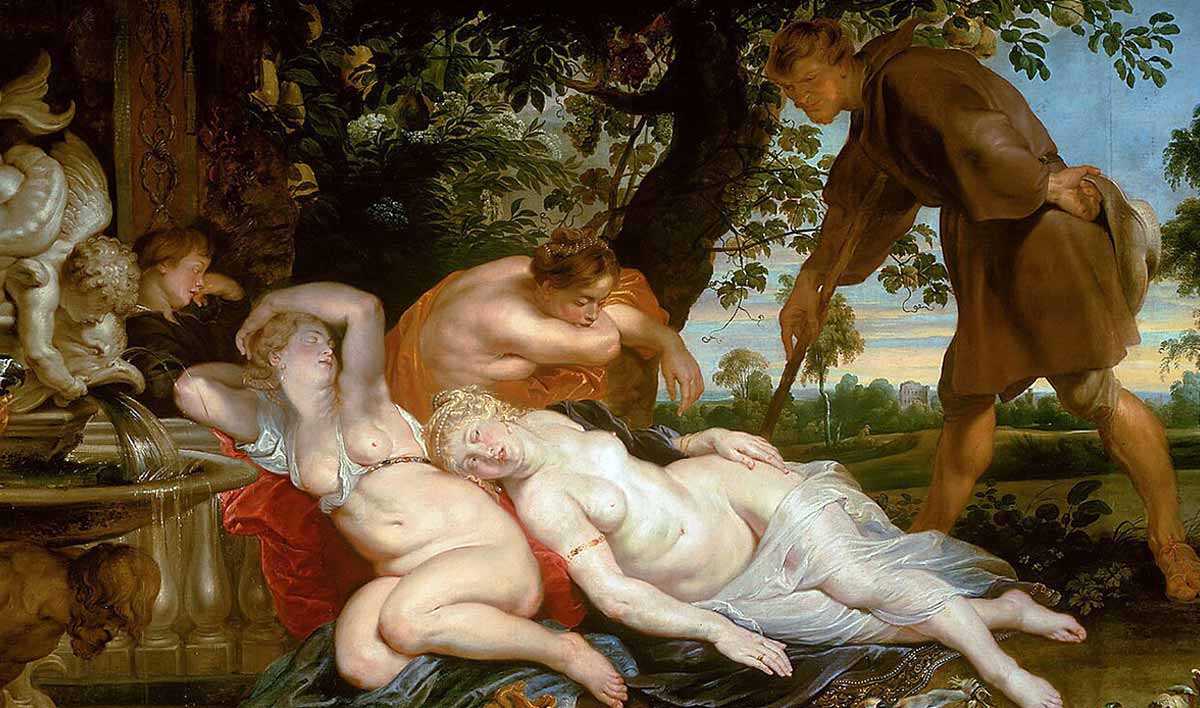
In the Decameron’s more “modern” world, the concept of love is also the subject of a radical transformation. In the last lines of Paradise (33, 145), Dante refers to God as “the Love that moves the sun and the other stars.” Conversely, Boccaccio shows love as a natural force that should not be repressed.
The numerous sexual references of the Decameron and the bawdy tone of a number of tales have led to much debate over the work’s moral values. Some believe Boccaccio showed a blatant disregard for the morality of his time. On the other hand, others argue that it is no longer possible to consider his work obscene, emphasizing that he simply approached the concept of love from a “naturalistic” perspective.
The Decameron’s Legacy: A Step Out of the Middle Ages

In his influential analysis of Italian literature, 19th-century literary critic Francesco De Sanctis referred to the Decameron as a “Human Comedy” that introduces a new worldview and moral order after Dante’s Divine Comedy.
De Sanctis’s view may imply an overly rigid divide between the Middle Ages and the Renaissance. However, the Decameron’s spirit, alongside its open celebration of ingenuity as a human virtue, is undeniably new, spearheading Humanism and the Renaissance. Indeed, Boccaccio’s collection of tales is both a celebration of all human experience, tragic and comic alike, and an attempt to raise vernacular literature to the status of the Classics.
In his later years, Boccaccio devoted much of his time to the study of Latin texts, and his Florentine house became a meeting spot for the circle of early Italian humanists. At the same time, he remained interested in Italian vernacular poetry. His Trattatello in laude di Dante (Little Tractate in Praise of Dante), written between 1351 and 1365, is a testament both to his passion for vernacular literature and admiration for Dante.
By the time of his death in 1375, a year after his friend and fellow poet, Petrarch, died, Boccaccio had already laid the foundations for the development of the Italian Renaissance.