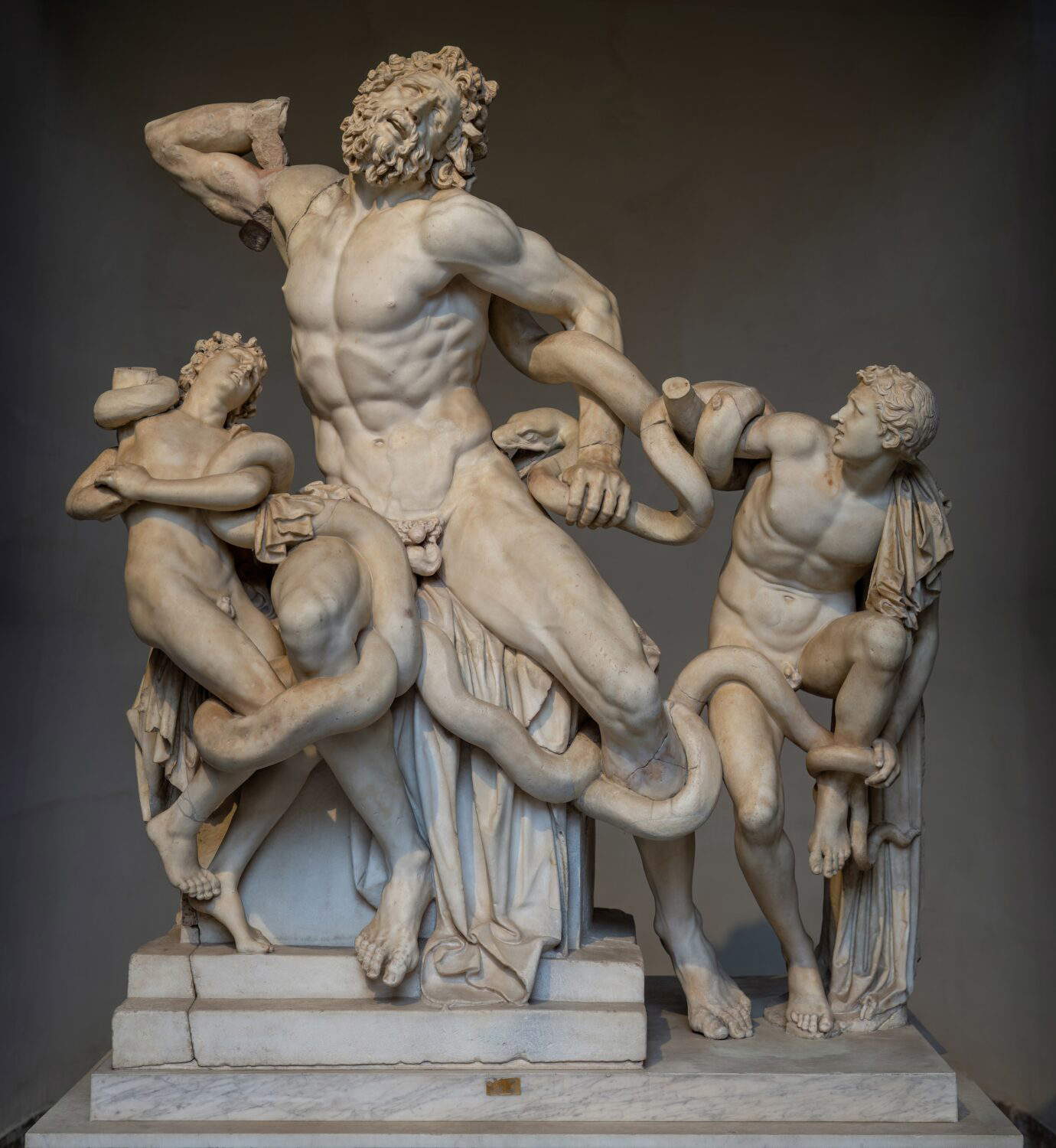
An ancient Greco-Roman marble statuary group featuring a muscular, bearded man—the priest Laocoön—and his two sons. They are entwined in the thick, writhing coils of two giant snakes. The father’s face is contorted in a visceral expression of agony, while the boys display terror and exhaustion as they are constricted.
Laocoön and His Sons - c. 40 BC – 20 AD (debated)

Object Record

Laocoön and His Sons

Agesander of Rhodes (wikidata.org), Athenodorus of Rhodes (wikidata.org), Polydorus (royalacademy.org.uk)

Genre:
Sculpture
Culture:
Hellenistic
Period:
Hellenistic
Date:
c. 40 BC – 20 AD (debated)
About:
A masterpiece of Hellenistic "baroque" dynamism, this monumental marble group captures the agonizing demise of the Trojan priest Laocoön and his sons. Strangled by sea serpents as divine punishment, their contorted forms and visceral expressions epitomize human suffering. Unearthed in 1506, the sculpture profoundly influenced Renaissance masters like Michelangelo, serving as a definitive archetype of anatomical precision and emotional pathos in Western art. It remains a cornerstone of the Vatican’s collection and a pinnacle of classical aesthetic achievement.
Alternate Title:
The Laocoön Group
Type of Work:
Marble Sculpture
Material:
White Marble
Dimensions:
H: 208 cm

Collection

Provenance:
Found 1506 in the vineyard of Felice de Fredis on the Oppian Hill, Rome; purchased by Pope Julius II; Vatican Museums (1506–present).
Institution:
Vatican Museums
Location:
Vatican City, Rome, Vatican City
Accession:
1059
Copyright Status:
Public Domain
Deep Links:

References

Authority Files:
VIAF: 69726398, LCCN: n85229141, GND: 118832107