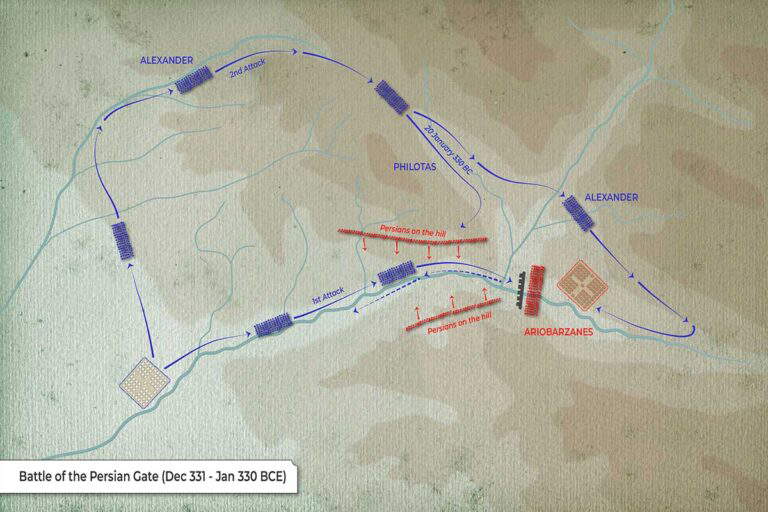
The Battle of the Persian Gate was a hard‑fought clash in the Zagros Mountains between Alexander the Great’s Macedonian army and a smaller Persian force commanded by Satrap Ariobarzanes. It took place in late December 331 BCE and culminated on 20 January 330 BCE.
-
- Blue blocks = Alexander the Great’s Macedonian army.
- Red blocks = Persian Infantry and missile troops under Satrap Ariobarzanes
Understanding the Map: What Happened at the Battle of the Persian Gate?
- Gateway to Persepolis: The Persian Gate (modern Tang‑e Meyran) controlled the only practical winter route from Mesopotamia into Persis. Whoever held it could block access to the Achaemenid heartland.
- Thermopylae‑style defense: Ariobarzanes positioned fewer than 10,000 men in a narrow, cliff‑lined pass, forcing Alexander’s larger army to attack uphill through a confined corridor—much like the Greeks’ stand at Thermopylae.
- Alexander’s setback and response: A frontal assault was smashed by missile fire and boulders from the heights. Refusing to retreat, Alexander spent days scouting goat trails, then led a night march over the ridges to fall on the Persians’ rear while a second column renewed the frontal push.
- Result: The Persian line collapsed in a double‑envelopment. Ariobarzanes was killed (or captured and executed), and the gate opened the road to Persepolis, which Alexander seized and later burned.
Strategic impact
- It removed the last organized obstacle in southern Iran.
- The victory showcased Alexander’s adaptability—turning an apparent dead end into a decisive triumph through reconnaissance and daring mountain manoeuvres.