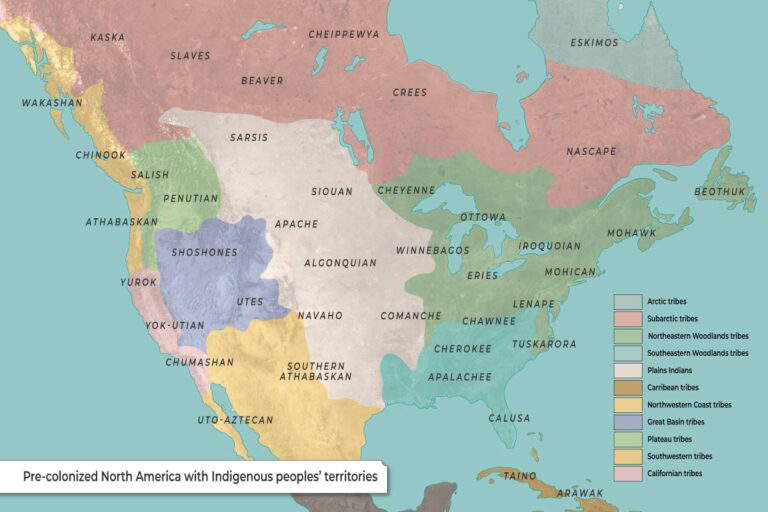
This map shows pre-colonized North America, depicting the approximate territories of Indigenous peoples prior to European colonization. Instead of modern political borders, it focuses on cultural and linguistic groups.
Each labeled region shows the dominant Indigenous group or language family. The background colors represent larger cultural or environmental regions:
| Color | Region | Notes |
| Light Blue | Arctic tribes | Eskimos, living in far north |
| Pink | Subarctic tribes | Crees, Nascape, Beaver, Slaves |
| Light Green | Northeastern Woodlands tribes | Iroquoian, Mohawk, Lenape, etc. |
| Teal | Southeastern Woodlands tribes | Cherokee, Apalachee, Calusa |
| Beige | Plains Indians | Cheyenne, Sioux, Comanche |
| Orange | Caribbean tribes | Taino, Arawak |
| Yellow-Orange | Northwestern Coast tribes | Wakashan, Chinook, Salish |
| Purple | Great Basin tribes | Utes, Shoshones |
| Olive Green | Plateau tribes | Penutian |
| Pale Yellow | Southwestern tribes | Navajo, Southern Athabaskan, Uto-Aztecan |
| Pale Pink | Californian tribes | Yurok, Yok-Utian, Chumashan |
Geographic Scope
- Covers modern Canada, the US, northern Mexico, parts of the Caribbean, and Arctic regions.
- Does not show all tribes — instead, it focuses on larger cultural-linguistic groups.
This map helps visualize:
- The rich diversity of Indigenous cultures before European arrival.
- The territorial spread of major Indigenous language families and cultural groups.
- How geography influenced cultural divisions (plains, forests, deserts, coastal regions).
Note:
- These boundaries were not as rigid as modern borders.
- Many tribes moved, migrated, or shared overlapping territories, depending on the season, alliances, and resources.